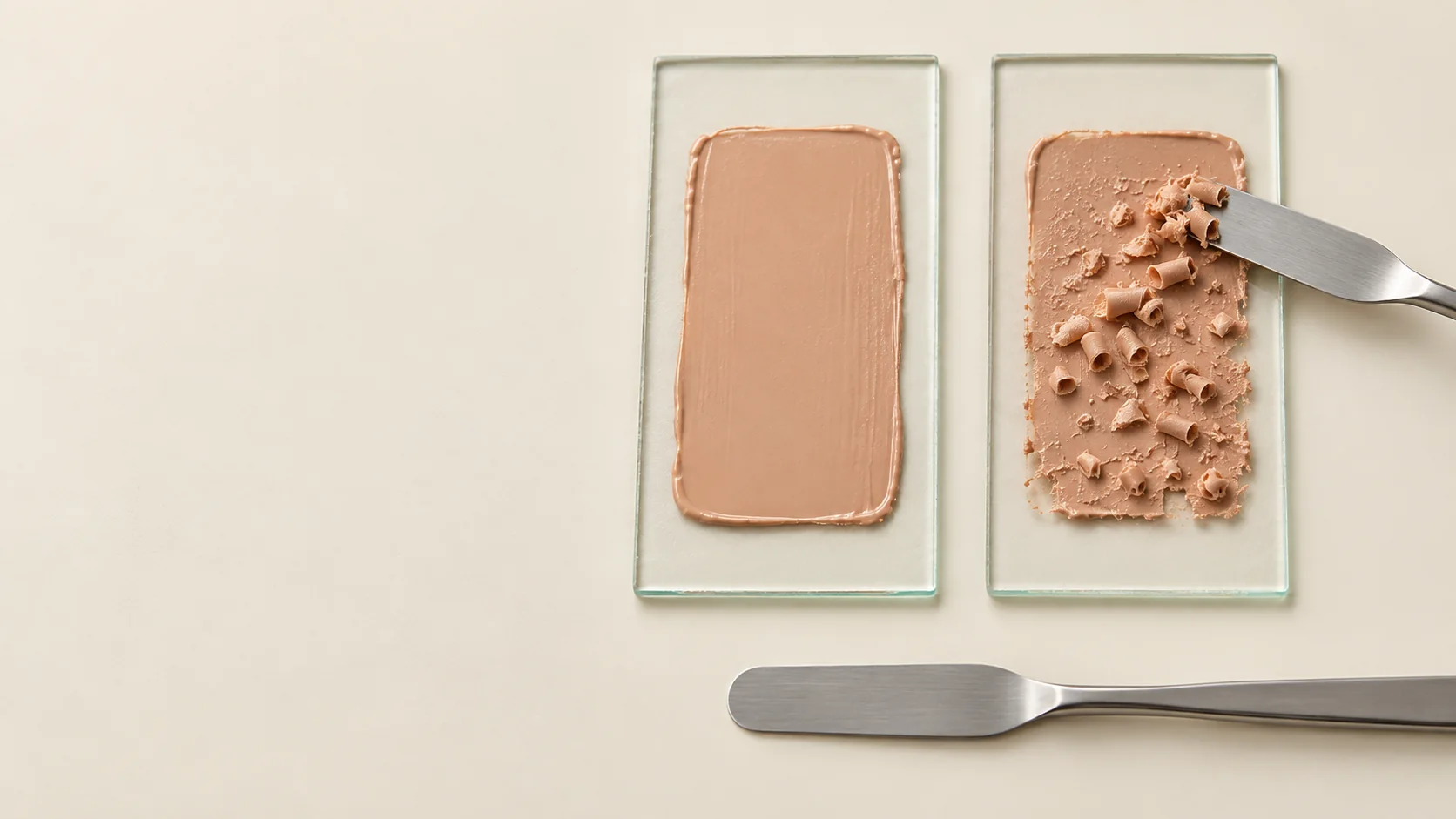
Pilling is the formation of visible rolls, flakes, or crumbs while layered products are spread or pressed. It is an interaction, not an ingredient-category verdict. A routine can pill because too much material remains on the surface, because a layer has not formed a stable film, because repeated rubbing gathers residue, or because several film-forming systems do not tolerate being mechanically reworked together.
The popular rule that “water-based and silicone-based products do not mix” is too crude to diagnose this. Water and silicones can coexist in complex emulsions, and an ingredient list does not disclose the finished formula’s exact concentrations, process, film strength, or compatibility with another finished product.
First distinguish pilling from flaking
Pilling usually appears as new soft rolls during friction. Pre-existing dry flakes lift from the skin in recognizable patches. Product can also ball on facial hair or around edges where application pressure increases. Stop if there is burning, persistent redness, swelling, or discomfort; troubleshooting makeup is not a reason to continue irritating skin.
Protect the non-negotiable layer
Do not reduce sunscreen below its labeled amount merely to make makeup sit better. FDA directions for sunscreen include generous, even application and application 15 minutes before sun exposure; follow the label for reapplication. The American Academy of Dermatology places moisturizer and/or sunscreen before makeup. If sunscreen is involved in the failure, adapt the cosmetic layers or choose a sunscreen you can apply correctly rather than treating adequate protection as the expendable variable.
The one-variable split test
Test on two comparable sections of the face or arm, using products suitable for that area. Photograph the start and result in the same light.
1. Amount: use your usual amount on side A and half as much of the cosmetic layer—not sunscreen—on side B. Keep motion and wait time equal.
2. Dry-down: on another day, keep amounts equal and compare your usual interval with a longer undisturbed interval. Use the product label as the first authority.
3. Friction: compare repeated circular rubbing with minimal pressing or short directional strokes.
4. Layer subtraction: keep sunscreen constant and omit one optional cosmetic layer, such as primer.
5. Pair isolation: test foundation over the sunscreen alone, then over sunscreen plus primer.
Change only one variable per comparison. Otherwise a successful side cannot tell you what fixed it.
How to interpret the result
- Less cosmetic product fixes it: total surface load was probably contributing. Scale back optional layers rather than protection.
- More undisturbed time fixes it: the earlier layer needed greater set or evaporation before mechanical work.
- Pressing fixes it but rubbing fails: friction and repeated reworking are central to the failure.
- Removing primer fixes it: that specific stack is the issue; this does not prove that every product sharing one highlighted ingredient will fail.
- Every combination pills in the same textured area: inspect application motion, hair, visible flakes, and residue before buying replacements.
What the ingredient list can tell you
It can identify declared ingredients and help you compare recurring materials. It cannot fully reconstruct the formula. Under FDA labeling rules, ingredients are generally listed in descending order, but ingredients at one percent or less and color additives have ordering exceptions. That is one reason an INCI list cannot establish exact concentration or predict application behavior by itself. Use it as a clue after a controlled test, not as the verdict.
A useful test log
Record products in order, approximate cosmetic amounts, sunscreen amount according to its label, minutes between layers, motion, tool, room conditions, and where pilling started. Add a close photograph. After three tests, patterns are more reliable than memory.
Evidence notes
- FDA sunscreen application guidance
- American Academy of Dermatology: skincare application order
- FDA Cosmetics Labeling Guide
Once the stack stops rolling, evaluate how the complexion layer itself moves and sets with Slip, Set, and Film.