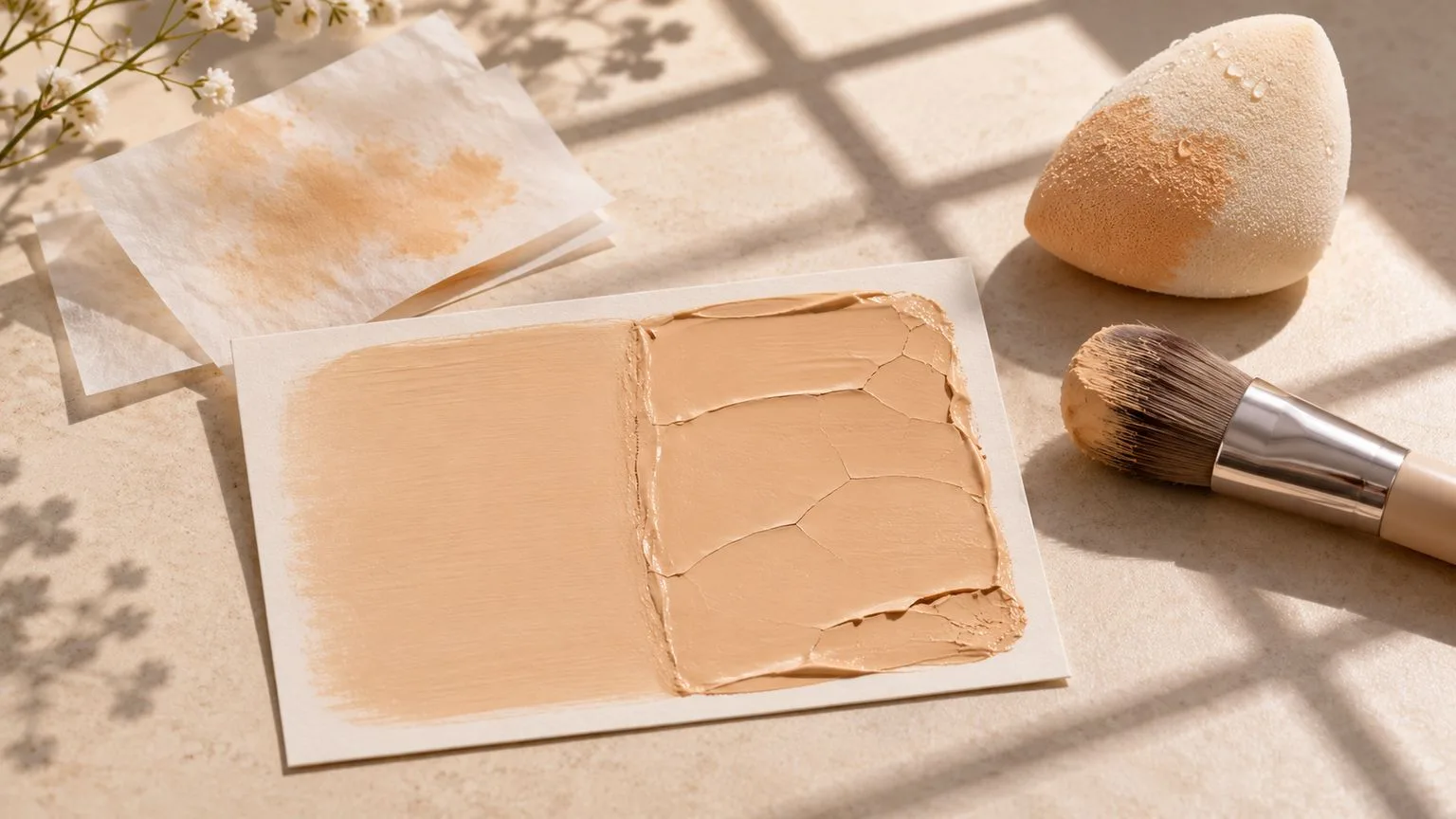
Foundation separating during wear is a film failure: the base parts or migrates, exposing skin in patches or fine channels. That is different from pilling, where product rolls into little balls while being applied, and flaking, where loose dry skin lifts with the makeup on it. The time of failure is the first useful diagnostic clue. A base that splits almost immediately calls for a different test from one that breaks around the middle of the day.
Separation is a wear failure, not an application failure
A finished foundation layer is never perfectly static. Facial movement bends it, skin oils change the surface beneath it, and touch or friction can displace it. Separation is what you see when the layer no longer looks continuous. The visible pattern matters: an oily opening around the nose suggests a different variable than a broken stripe at a smile line.
Pilling usually appears during layering or blending, often as rolls of material under a moving finger or brush. It is a neighbouring issue covered in why makeup pills. Flaking means surface skin itself is lifting or looking rough under the coating; it is not automatically evidence that two makeup products are incompatible.
Take a photo as soon as the base is finished. Compare it with the same zones later under the same light. If the change appears within minutes, ask whether the product ever formed an even layer. If it appears around two hours, look at oil, touch and movement. End-of-day change can simply reflect accumulated wear, though the zones still tell you what to examine next.
Read the map: where it breaks tells you what to test
Sides of the nose and inner cheeks. These areas can combine surface oil, pores, a moving fold and heavy product deposit. If you see small channels beside the nostrils, first reduce the amount left in that area and check whether the base was rubbed while setting.
Chin. Hands, collars and repeated movement can break a thick film. First compare the result on a day when you avoid touching the chin, while keeping the same products.
Forehead. A smooth-looking application that later becomes shiny and patchy may signal a film disturbed by surface oil. Test less product and selective powder instead of immediately adding more coverage.
Smile lines and around the mouth. The base bends with expression. Thick coverage can crease and then part along the fold. Build coverage in thinner layers and avoid depositing the same amount used on a comparatively still area of the cheek.
Under the eyes. Constant movement and excess material can create cracks that look like separation. Reduce layer thickness and avoid vigorous buffing over a delicate base; do not interpret all creasing as product failure.
Dry patches and visible texture. Product can catch on an uneven surface and reveal gaps. Check whether this is film separation or skin flaking before changing formula. Aggressively polishing the area with a brush may make both look worse.
Jaw and hairline. Hair, clothing and a phone can repeatedly contact these margins. Test a thinner edge and reduce friction before blaming the formula. The location of wear is often more informative than the overall finish.
These are hypotheses to test, not universal diagnoses.
Skin prep and timing under the base
Layering more skincare does not automatically create a smoother foundation. If a leave-on layer is still mobile when foundation arrives, the makeup may move with it. Let each preparatory layer settle according to its directions and check whether excess remains on the surface. Heavy emollient preparation under a long-wear formula may feel comfortable yet make control harder in an oily area.
Never reduce sunscreen below its labelled application amount to make foundation sit better. Instead, allow it to settle as directed, adjust the makeup technique and test a different compatible makeup approach if necessary. SPF protection is not the variable to sacrifice for appearance. Layer compatibility deserves its own diagnosis, not a guess based on labels alone.
No ingredient-level rule is being claimed here. A finished foundation's behaviour must be tested as a complete formula on the intended base; ingredients listed separately do not prove that two products will or will not work together.
Amount, layers and how the film is built
A thick film is less flexible in moving zones and gives more material for surface oil to disturb. Build coverage where it is actually needed instead of applying the same heavy layer everywhere. Deposit a thin base first, then add a small amount only to areas still needing coverage. Wait until the earlier layer has reached the product's suitable setting point before adding another.
Some formulas remain workable for longer; others set quickly and drag when brushed again. The interaction of slip, set and film is explained in foundation film behaviour. The important observation is whether a second layer sits on the first or dissolves and shifts it. Record that result, not just whether the finish initially looks smooth.
Tools, pressure and powder
A damp sponge used with light pressing can leave a thinner, more even-looking layer, although excessive pressing may also lift coverage. A brush used for buffing spreads product across a larger area and can disturb an already settling layer when pressure is too high. Fingers warm and distribute product over a small contact area but can leave uneven thickness if the same patch is repeatedly rubbed.
Compare application methods with the same amount of product. The pressure-and-diffusion guide provides a useful framework for where pigment goes, while brush density and pickup explains why brushes do not distribute identical loads.
Powder belongs where the film repeatedly breaks first, not automatically in a heavy layer everywhere. Press a controlled amount into the relevant zone rather than sweeping back and forth across an unsettled base. Excess powder over existing oil can produce a visible build-up without restoring the film underneath.
Wear conditions you cannot fix with product
Touching the face, a mask rubbing against the cheeks, glasses on the nose, warmth, humidity and a long day all change what happens after application. Some wear is inevitable; a midday touch-up may be more realistic.
Blotting removes surface oil before a cautious repair. Adding repeated powder directly over oil can turn a separated area into a thicker, uneven deposit. If the underlying film has visibly moved, carefully evening the area may work better than covering it blindly.
The elimination test
1. Keep the same foundation, preparatory products, tools available and ordinary wear setting.
2. Photograph the nose, chin, forehead, mouth, under-eyes and jaw immediately after application in the same light.
3. Photograph those zones again around two hours and around six hours after application, using consistent angles.
4. On the next wear day, change only the amount of foundation while keeping the other variables stable.
5. On another wear day, restore the baseline amount and change only the settling time between preparation and foundation.
6. Test a single change in tool or pressure on a separate wear day; do not combine it with a new product.
7. Test selective powder placement on a further day, leaving everything else constant.
8. Compare the failure zone and onset time rather than choosing solely by the first application photo; stop testing if irritation develops.
Small controlled comparisons beat changing the whole routine.
Quick diagnosis table
| Zone | When it appears | Likely variable | Change first |
|---|---|---|---|
| Nose sides | Early or mid-wear | Thick deposit plus oil and friction | Reduce product near folds |
| Inner cheek | Mid-wear | Moving base and surface oil | Press less, let layers settle |
| Chin | Mid-wear | Touch and movement | Reduce friction |
| Forehead | Midday | Oil and overly thick film | Use thinner coverage |
| Smile lines / mouth | During wear | Repeated bending | Lighten film in folds |
| Under eyes | Soon after movement | Excess product | Reduce amount, avoid buffing |
| Dry texture | At application or later | Flaking or uneven surface | Identify flaking first |
| Jaw / hairline | Later in day | Hair, collar or phone friction | Keep edge thin |
If there is burning, persistent redness, swelling or discomfort, stop testing and seek advice from a doctor or dermatologist. Persistent skin problems are not a makeup-technique puzzle.